
On the weekend that we went West to Cape Coast and beyond, we stayed overnight at the Hans Cottage Botel, a rather excellent little spread that is nestled inland, in the bush between Kakum National Park and the coast. We originally discovered it on our own, only to discover that it was featured in "the book" (Bradt's Ghana) all along. I'm not sure why we resist as the guide has yet to fail us. As you can see by the pictures above and below, the highlight of the "botel" was the fact that the restaurant, bar and gift shop were on stilts in a swamp inhabited by several Nile crocodiles!

The restaurant area was walled in, but the walkway railings were just open enough to allow for a Finn-sized morsel to hop into the water to "play" with the crocodiles (Finn utters a throaty "oooohhhhh" right about now). The parents were definitely on high alert and we resisted the photo-opportunity that presented itself as Cohen begged us to let him touch the crocodile's tail as it sunned on the shore. A number of tourists did this and I had clear images of
When Animals Attack and
Faces of Death, as will those of you have seen either of these programs will. Feel free to use your imagination to picture Cohen touching the tail, as we (in a rare moment of parenting wisdom) exercised our judgement. Needless to say, we are still enjoying Cohen's company to this very day!
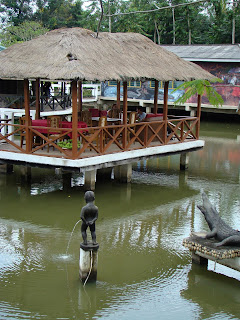
At this time of year, the resort was all but empty--aside from the one tour bus that came and went--so we had the run of it. The above peeing statue was almost as big a hit as the crocodiles and it is also symbolic of every road trip we've taken as the men (and sometimes the women) let it fly whenever the urge takes them. Carmilla and I politely avert our eyes and say nothing while Brontë giggles with mischief!

There are many levels of accommodation, but we (out of necessity) opted for one of the chalets, conveniently and comfortably distant from the crocodiles. The chalet was actually a massive two bedroom house, with a full kitchen, dining room and living room. A bit of bug spray, a tangle with a rather terrifying looking spider, and a lizard chased out with a broom, and we were ready to move in! It was pretty reasonably priced (160 Ghana Cedis) as it included breakfast for all, use of the pool, and a room for Douglas, our trusted driver. The pool was pretty fantastic and exactly what we needed. It was surrounded by a kiddie wading pool that went a good long way to keeping everyone amused and cool. The kids even taught Douglas to pencil swim. We joked that we are turning Douglas, son of farmers, into a man of the sea. The resort has managed to be eco-friendly as it is embedded in a habitat rich with wildlife, including dozens of birds, and even monkeys (though we didn't catch a glimpse). There are trails that weave in and out of the bush and on the weekends, there is entertainment. We ate Fan ice cream and danced to highlife music after supper, and the kids were thrilled. Carmilla and I seem to have replaced coffee with Star beer...not sure that this is a good thing!

The botel is about two hours from the city, so we won't likely come back here very often. This is one of the major advantages of being along a coast littered with resorts as we can dash away for one night of bliss whenever the city starts to get the better of us. We are currently looking for a city resort where we can use the pool, access the beach, and have a little something to eat, without the overnight charge or two hour drive. The day-user fee is usually 5 Cedis for adults and less for children, so we'll let you know when we find one.

 On the weekend that we went West to Cape Coast and beyond, we stayed overnight at the Hans Cottage Botel, a rather excellent little spread that is nestled inland, in the bush between Kakum National Park and the coast. We originally discovered it on our own, only to discover that it was featured in "the book" (Bradt's Ghana) all along. I'm not sure why we resist as the guide has yet to fail us. As you can see by the pictures above and below, the highlight of the "botel" was the fact that the restaurant, bar and gift shop were on stilts in a swamp inhabited by several Nile crocodiles!


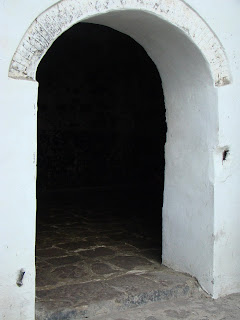 It was pointed out, as we were standing in the small, lightless, featureless dungeon (doorway above) where over a hundred women were stacked to await systematic rape, torture and transport (should they prove their market value by surviving long enough to be shipped), that the stench of barbaric containment and inhuman conditions was very much alive in the walls, and it was hard to deny. If my use of language comes of as overly graphic or terse, I can assure you that this is only a gentle whisper compared to the nature of our guide’s description. While it was a little awkward explaining and decoding what we had heard to the children after the tour, it is the truth, and the truth is always necessary when setting to the twin tasks of remembering and paying due respect.
 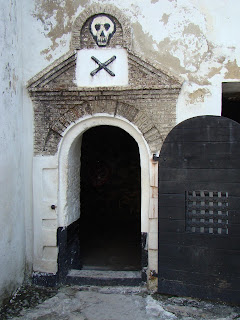 The private tour (included in the modest admission charge) was informative, moving and disturbing in equal parts. We were ushered through the castle, much as a slave would have been, so that we could have some small understanding of what went on inside the dense, white walls of this seaside fort. The cell (pictured above) would house up to thirty Africans who had been condemned to death after being brought to the fort. The room had no facilities and the prisoners would be left together in the cell until the last one was dead.
 This slender gap in the castle wall was the last time many would feel their feet on African land, as they were loaded onto waiting ships. As we passed—literally and figuratively—back through the “door of no return,” we were encouraged to utter a pledge of “never again.” I must say that while the story is not mine (though admittedly, as a descendant of the Britain, I bear at least some of the responsibility), I uttered the pledge with as much sincerity and conviction as I have ever spoken. As we escaped the dungeon, shifting once more into the warm African light, we were far better off knowing this truth with our eyes and within our hearts, than we would ever be resting in ignorance.
 There are a number of Africans who believe that these buildings must be torn down so that the terrible past can be buried. It does seem somewhat grotesque that this has become one of West Africa’s most important tourist “attractions.” I must admit—with no small degree of shame—to feeling something akin to what I felt when I first laid eyes on some of the castles in England and Scotland: a mix of awe and admiration. For the most part, the history and idealism of the “great man” (in Africa, Canada, or elsewhere) is a fallacy and a travesty perpetuated on countless millions, even to this day. However, I don’t think that tearing down the buildings—now rightfully in the hands of Ghanaians, whose story it is to tell—will improve the chances that this will “never again” take place. The above picture of a midday football match may seem a little out of place, given the content of this entry, but it was very much "in place" as I snapped it from atop the castle wall. It provided a degree of comfort to know that in many ways, Africa is alive and well.
  We went to the city of Cape Coast, the location of the other, perhaps better known castle in the area, but we felt we were done for the day so we did not enter. We intend to return and will likely bring any visitors that we have to one of the two castles, to hear this story again and pay our respects.
