
When I save the edited pictures for my blog, they go into a folder named Ghana Highlights, though in the case of such "attractions" as the colonial Fort Sao Antonio in Axim, the title doesn't feel exactly appropriate. The fort has been many things in its roughly five hundred year history, but most unforgettably it was a part of the capture and trade of millions upon millions of Africans throughout the continent. Lesser known and somewhat smaller than its slightly older cousin at Elmina, this historic building feels a little more quaint and undiscovered, and we had it entirely to ourselves, except for our remarkably well-informed and patient guide.

Built by the Portuguese in the sixteenth century, the fort was soon captured by the Dutch and eventually fell into the hands of the British, before being returned to the people of Ghana just over fifty years ago (to coincide with Independence). This fort was by no means as extravagant (for the chosen few) as some of its larger counterparts, but its past was just as dark. We were shown the almost lightless, relatively airless cells where dozens of men, women and children were stacked into to await trips through the point of no return, if they lived that long. The guide kept reminding us that they would be locked away for "three good months," with the dead. In this case, the point of no return involved a drop into a lower chamber, followed by a march to the nearby lighthouse island, where they were picked up. Many were traded for salt or other goods provided at the fort and it was thought that most people had no idea where their relatives were going. It was often thought to be a better life--how mistaken they were.

The most significant point of the tour for Brontë (who is becoming a romantic well before either of her parents are ready to deal with!) was the story about the director of the fort who fell to his death after seeing a beautiful captive being marched across to the island. He is the buried in one of the fort courtyards, leaving only his tomb and his somewhat suspect story to remember him by. This is the view from the place where he was reputed to have fallen from.

I would have to say that Axim, for its part as a former port town and thriving fishing village, has fared reasonably well and is much prettier town than Elmina. There are several noteworthy colonial age buildings that stand out from atop the fort's walls, including an early bank and a hotel. I don't think tourists are nearly as common out this way so people were content to let us wander around pretty much undisturbed. Of course we had several dozen children and a few adults who offered to watch our lone vehicle in parking lot. While we did hand out a few cedis worth of "dashes" (and a pack of Mentos gum) when we were leaving, these were the only people around and we could almost always see the van from the roof, so it was more of gesture than a necessity.


The learning associated with visits to locales such as the forts is not easy, but it has been an important part of our family's cultural and historic learning while in Africa. I'm sure each of us will take away something different, but I have a much deeper sense of what it means to be a developing nation. That is to say, I know the legacy and damage done, and more about what exactly Ghana--and so many other African nations--are developing from. It was always an uphill climb and this nation has really only been at it, on its very own terms, for a little over fifty years. How long does it take to re-build a nation or a people? Canada might do well to ask such questions regarding our First Nations population.

 When I save the edited pictures for my blog, they go into a folder named Ghana Highlights, though in the case of such "attractions" as the colonial Fort Sao Antonio in Axim, the title doesn't feel exactly appropriate. The fort has been many things in its roughly five hundred year history, but most unforgettably it was a part of the capture and trade of millions upon millions of Africans throughout the continent. Lesser known and somewhat smaller than its slightly older cousin at Elmina, this historic building feels a little more quaint and undiscovered, and we had it entirely to ourselves, except for our remarkably well-informed and patient guide.

 Despite myself, I am growing increasingly fond of Britain's rather sausage-shaped thumb print on this country (and, quite frankly, on the world). One of the high streets in Accra's city centre district of Osu is called Oxford Street and one can easily imagine that they are in London based on the British take on international flare that lives on this stretch. Carmilla and I have already re-instituted our prior ritual (from my teaching stint in Leicester) of evening tea. We even managed to find PG Tips at the popular ex-pat Max Mart, a grocery store with a whole lotta Britain goin' on (but more on food and drink in a later posting). It is amazing how much traffic one can survive (more on traffic...again, you'll have to stay tuned) when you know that the promise of a hot cuppa awaits. Alas, I digress and have meandered from the intended path...
 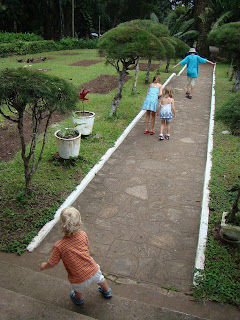 We were a little surprised to discover that one of the jewels in Ghana's crown (if you'll pardon the expression), the Aburi Botanical Garden in the Eastern region, was planted (through, I'm certain, the not-so-discreet-or-amusing use of slave labour--no pun intended here!) by none other than the colonials who occupied this country prior to independence some 50+ years ago. A drive of about an hour planted us (now, please pardon the pun) in the midst of one of the most impressive gardens we've ever been privy to.
  It would appear that even Douglas, our hired driver, is impressed by the cotton silk trees planted some 150 years ago. This picture reminds me of similar pictures I have seen and taken of Carmannah in BC. It is hard not to stand in quiet awe and contemplation when in the presence of the planet's giants.
  Not far from the gardens, the first cocoa bean planted along the Gold Coast is still growing at the Tetteh Quarshie plantation. The industrious and well-travelled local man Tetteh Quarshie reportedly brought cocoa to the region and left his mark forever on this area of West Africa. This was our first close-up look at what is arguably the most important export--certainly from Carmilla's perspective--of Ghana (I know, we love our oil too...I mean what's not to love about oil?). From little professor Cohen's point-of-view, this praying mantis was a definite highlight!
 While I am still learning the strengths and weaknesses of my new camera (and its user), this snap of one of the more brightly coloured sights at the garden will have to stand alone. Needless to say, Carmilla and I are already planting our Accra garden in our imaginations!
 We lingered for a good, long while in the garden, and certainly felt that we got more than our seven Ghana Cedis worth (for the carload...Butchart Gardens eat your heart out!!). The air was cooler due to the elevation and the vegetation, so we were truly comfortable outdoors in a way we have rarely been as yet. On the way home, we pulled over and I snapped this hazy landscape picture of the northeastern edge of Accra.

